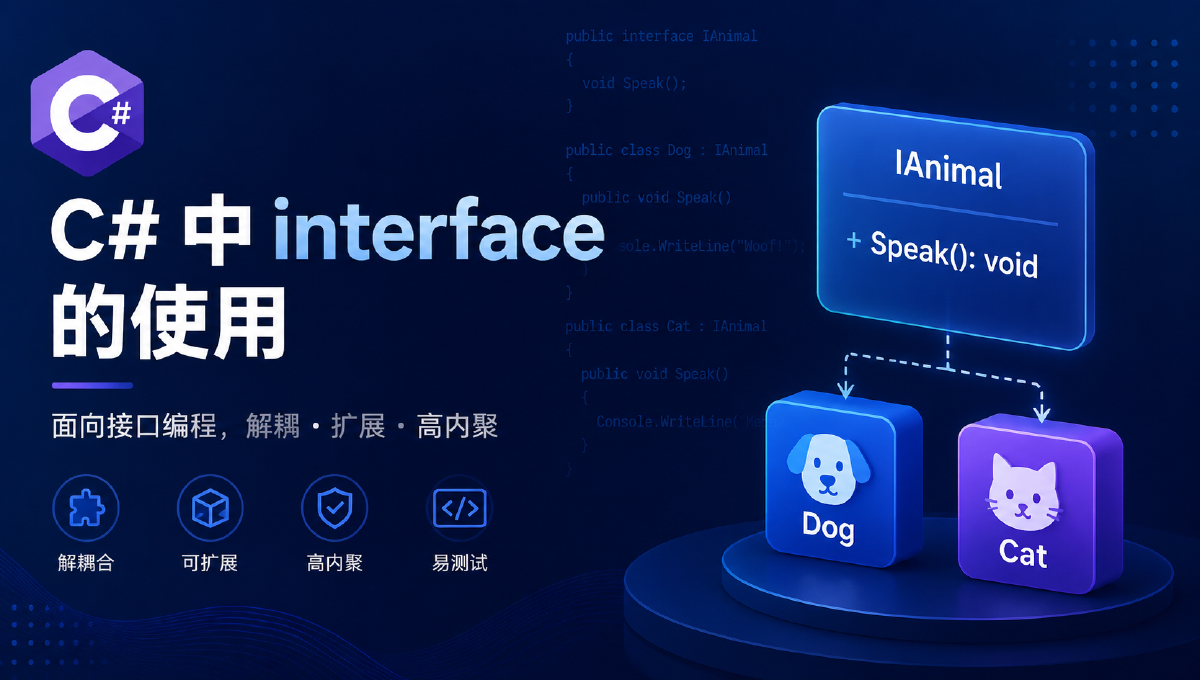
1. 接口的本质认知 #
1.1 接口不只是"隔离变化" #
很多开发者认为接口的作用就是"隔离变化",这个理解是对的,但不完整。
更准确地说,接口是:
| 维度 | 说明 |
|---|---|
| 契约 | 调用方只关心"你能做什么" |
| 角色 | 一个类可以扮演多个角色 |
| 边界 | 上层依赖抽象,下层提供实现 |
| 多态入口 | 同一段代码可以替换不同实现 |
“隔离变化"是接口带来的结果,而不是接口的全部意义。
1.2 接口的核心价值 #
接口 = 抽象"角色/能力"的工具
隔离变化 = 使用接口之后自然带来的收益
2. 隐式接口实现 #
2.1 定义 #
隐式实现是最常见的接口实现方式。接口成员直接作为类的公共成员暴露,既可以通过类实例调用,也可以通过接口引用调用。
2.2 写法 #
public interface ILogger
{
    void Log(string message);
}

public class ConsoleLogger : ILogger
{
    public void Log(string message)
    {
        Console.WriteLine(message);
    }
}
2.3 特点 #
必须是 public
// 正确
public void Log(string message) { }

// 错误:隐式实现不能是 private/protected
private void Log(string message) { }
既可以通过类调用,也可以通过接口调用
// 通过类实例调用
var logger = new ConsoleLogger();
logger.Log("hello");

// 通过接口引用调用
ILogger iLogger = new ConsoleLogger();
iLogger.Log("world");
2.4 适合的场景 #
- 接口方法本来就是类的自然能力(主要职责)
- 你希望调用方直接从类实例上看到它
- 接口就是这个类的主要身份之一
典型例子:
// UserRepository 实现 IUserRepository
public class UserRepository : IUserRepository { }

// EmailSender 实现 IMessageSender
public class EmailSender : IMessageSender { }

// FileLogger 实现 ILogger
public class FileLogger : ILogger { }
3. 显式接口实现 #
3.1 定义 #
显式实现不将接口成员暴露为类的公共 API,只有在将对象转型为对应接口时,该成员才可见。
3.2 写法 #
public interface ILogger
{
    void Log(string message);
}

public class ConsoleLogger : ILogger
{
    // 显式实现:不写访问修饰符,加上接口名前缀
    void ILogger.Log(string message)
    {
        Console.WriteLine(message);
    }
}
注意: 显式实现不能加访问修饰符(
public、private等),写了会编译报错。
// 错误写法
public void ILogger.Log(string message) { } // 编译错误
3.3 特点 #
不能直接通过类实例调用
var logger = new ConsoleLogger();
logger.Log("hello");         // 编译错误,不可见

// 必须转型为接口后才能调用
ILogger iLogger = logger;
iLogger.Log("hello");        // 正确

((ILogger)logger).Log("hello"); // 也正确
成员只在"接口视角"下可见
显式实现不是说这个方法不存在,而是说:这个方法只在"你把对象看作某个接口"时才出现。
3.4 适合的场景 #
场景一:避免污染类的公共 API #
public interface IInternalAudit
{
    void Audit();
}

public class OrderService : IInternalAudit
{
    // 主职责:公开暴露
    public void CreateOrder()
    {
        Console.WriteLine("Create order");
    }

    // 辅助契约:隐藏在类 API 之外
    void IInternalAudit.Audit()
    {
        Console.WriteLine("Audit order service");
    }
}
var service = new OrderService();
service.CreateOrder(); // 可见
// service.Audit(); // 不可见
((IInternalAudit)service).Audit(); // 可见场景二:多个接口成员同名但语义不同 #
public interface IReader
{
    void Open();
}

public interface IWriter
{
    void Open();
}

public class FileDevice : IReader, IWriter
{
    void IReader.Open()
    {
        Console.WriteLine("Open for reading");
    }

    void IWriter.Open()
    {
        Console.WriteLine("Open for writing");
    }
}
var device = new FileDevice();
((IReader)device).Open(); // Open for reading
((IWriter)device).Open(); // Open for writing如果用隐式实现,只能有一个
public Open(),两个接口共享同一个实现,当语义不同时这是错误的。
场景三:兼容旧接口 / 辅助接口 #
.NET BCL 中大量使用这种手法:
public class MyCollection<T> : IEnumerable<T>, IEnumerable
{
    // 主 API:泛型版本,公开暴露
    public IEnumerator<T> GetEnumerator()
    {
        throw new NotImplementedException();
    }

    // 兼容旧接口:显式实现,不污染现代 API
    IEnumerator IEnumerable.GetEnumerator()
    {
        return GetEnumerator();
    }
}
场景四:IDisposable 的显式实现 #
当 IDisposable 不是类的主要能力,而只是辅助资源管理时:
public class DataExporter : IDisposable
{
    private readonly FileStream _stream;
    private bool _disposed;

    public DataExporter(string filePath)
    {
        _stream = new FileStream(filePath, FileMode.Create);
    }

    // 主 API,清晰暴露
    public async Task ExportAsync(IEnumerable<Order> orders)
    {
        if (_disposed)
            throw new ObjectDisposedException(nameof(DataExporter));

        foreach (var order in orders)
        {
            var bytes = Encoding.UTF8.GetBytes(order.ToString() + "\n");
            await _stream.WriteAsync(bytes);
        }
    }

    // 显式实现,不污染主 API
    void IDisposable.Dispose()
    {
        if (_disposed) return;
        _stream.Dispose();
        _disposed = true;
    }
}
// using 语句能正确触发显式实现的 Dispose()
using var exporter = new DataExporter("output.txt");
await exporter.ExportAsync(orders);
// 块结束时自动调用 IDisposable.Dispose()3.5 一个高级用法(慎用) #
同一个接口,同时存在隐式和显式实现:
public interface IMessage
{
    string GetText();
}

public class Notice : IMessage
{
    // 隐式实现
    public string GetText() => "public text";

    // 显式实现
    string IMessage.GetText() => "interface text";
}
var notice = new Notice();
Console.WriteLine(notice.GetText()); // public text
IMessage msg = notice;
Console.WriteLine(msg.GetText()); // interface text建议:能不用就别用。 这会让行为分裂,增加理解成本。除非你非常明确地要区分"类视角"和"接口视角"的行为,否则尽量避免。
4. 隐式 vs 显式:如何选择 #
4.1 核心区分 #
隐式实现:"这是我的公开能力。"
显式实现:"这是我在扮演某个接口角色时才有的能力。"
4.2 选择标准 #
优先使用隐式实现,如果:
- 这个方法本来就是类的自然能力(主职责)
- 你希望调用方直接从类实例上看到它
- 接口就是这个类的主要身份之一
使用显式实现,如果:
- 不想将某个接口成员暴露到类的公共 API
- 多个接口成员重名,但语义不同(强信号)
- 这是兼容性接口、框架辅助接口、低优先级接口
- 想明确区分"类本身职责"和"接口角色职责”
- 想缩小类对外暴露的表面积,减少误用
4.3 对比速查表 #
| 特性 | 隐式实现 | 显式实现 |
|---|---|---|
| 访问修饰符 | 必须 public |
不能有访问修饰符 |
| 通过类实例调用 | 可以 | 不可以 |
| 通过接口引用调用 | 可以 | 可以 |
| 暴露在类公共 API | 是 | 否 |
| 适合场景 | 主职责、主能力 | 辅助契约、冲突解决 |
5. 接口 vs 抽象类 #
5.1 核心区别 #
接口:描述"能做什么"  → 角色 / 能力 / 契约
抽象类:描述"是什么,并且已经有一部分共性实现"  → 基类 / 模板 / 骨架
5.2 多角色 vs 单继承 #
C# 类只能继承一个基类,但可以实现多个接口:
// 一个类扮演多个角色
public class FileCache : ICache, IDisposable, IAsyncDisposable
{
}接口的天然优势:一个类可以扮演多个角色,而抽象类做不到。
5.3 什么时候用接口 #
只需要约束,不需要共享实现:
public interface ISerializer
{
    string Serialize<T>(T obj);
}

// 三种实现完全不同,接口非常合适
public class JsonSerializer : ISerializer { }
public class XmlSerializer : ISerializer { }
public class YamlSerializer : ISerializer { }
5.4 什么时候用抽象类 #
需要共享实现、共享状态、模板流程:
public abstract class FileImporter
{
    // 共享流程(模板方法)
    public void Import(string path)
    {
        ValidatePath(path);
        var content = File.ReadAllText(path);
        Parse(content);
        Save();
    }

    // 共性实现
    protected virtual void ValidatePath(string path)
    {
        if (string.IsNullOrWhiteSpace(path))
            throw new ArgumentException(nameof(path));
    }

    // 子类各自实现
    protected abstract void Parse(string content);
    protected abstract void Save();
}
需要共享状态:
public abstract class WorkerBase
{
    // 共享字段和构造函数
    protected readonly ILogger _logger;

    protected WorkerBase(ILogger logger)
    {
        _logger = logger;
    }
}
5.5 接口 + 抽象类组合使用(成熟系统的常见做法) #
// 对外:依赖接口(稳定契约)
public interface IMessageSender
{
    Task SendAsync(string message);
}

// 对内:抽象类沉淀共性(模板流程 + 共享状态)
public abstract class MessageSenderBase : IMessageSender
{
    protected readonly ILogger _logger;

    protected MessageSenderBase(ILogger logger)
    {
        _logger = logger;
    }

    public async Task SendAsync(string message)
    {
        Validate(message);
        await SendCoreAsync(message);
        _logger.LogInformation("message sent");
    }

    protected virtual void Validate(string message)
    {
        if (string.IsNullOrWhiteSpace(message))
            throw new ArgumentException(nameof(message));
    }

    protected abstract Task SendCoreAsync(string message);
}

// 具体实现:只填差异部分
public class EmailSender : MessageSenderBase
{
    public EmailSender(ILogger<EmailSender> logger) : base(logger) { }

    protected override Task SendCoreAsync(string message)
    {
        Console.WriteLine($"Email: {message}");
        return Task.CompletedTask;
    }
}
设计原则:
- 接口负责抽象边界
- 抽象类负责沉淀共性
5.6 选择口诀 #
优先用接口,如果你在表达:
- 某种能力 / 某种边界 / 某种可替换实现
- 某种策略 / 某种外部依赖
优先用抽象类,如果你在表达:
- 一组对象的共同父类 / 有明确继承关系
- 有共享实现 / 有共享状态 / 有模板流程
5.7 对比速查表 #
| 维度 | 接口 | 抽象类 |
|---|---|---|
| 多继承 | 支持多个 | 只能单继承 |
| 共享实现 | 不擅长(default 实现慎用) | 擅长 |
| 共享状态(字段) | 不支持 | 支持 |
| 构造函数 | 没有 | 有 |
| 适合表达 | 角色 / 能力 / 契约 | 家族 / 骨架 / 模板 |
| 典型例子 | ILogger ICache |
Stream ControllerBase |
6. 什么时候不要定义接口 #
这部分比"什么时候定义接口"更重要。很多项目的问题,不是接口太少,而是接口太多、太空、太假。
6.1 没有替换价值时,不要急着定义接口 #
// 如果 TaxCalculator 没有多种实现、不是边界、不需要多态
// 直接用具体类即可
public class TaxCalculator
{
    public decimal Calculate(Order order) { ... }
}

// 不必要的接口定义
public interface ITaxCalculator
{
    decimal Calculate(Order order);
}
6.2 纯数据对象不要抽象接口 #
// 没有意义
public interface IUserDto
{
    string Name { get; set; }
}

// 直接用数据类
public class UserDto
{
    public string Name { get; set; }
}
以下类型通常不需要接口:
DTO/VO/ViewModel- 领域实体(
Order、User、Product) Record类型Value Object
6.3 稳定的工具类,不需要强行接口化 #
// 如果没有多种哈希策略切换、没有测试替身需求
// 直接用具体类
public class Md5Hasher
{
    public string Hash(string input) { ... }
}
6.4 应用内部的实现细节类不需要接口 #
// 只在程序集内部使用,变化可能性低
internal class OrderNumberGenerator
{
    public string Generate() { ... }
}
6.5 不要为了"方便 Mock"而滥造接口 #
错误顺序:为了 mock → 建接口
正确顺序:设计需要抽象 → 建接口 → 测试顺便受益
天然应该抽象的依赖(测试只是附带收益):
- 数据库访问
- 第三方 HTTP 调用
- 消息队列
- 缓存
- 文件系统
- 时钟、随机数
不需要为测试而强行接口化的类:
- 纯业务计算类
- 无外部依赖的领域逻辑
6.6 不要为了"看起来规范"而机械配对接口 #
// 典型反模式:一比一机械配对,没有抽象价值
public interface IOrderService { ... }
public class OrderService : IOrderService { ... }

public interface IUserManager { ... }
public class UserManager : IUserManager { ... }

public interface IProductHelper { ... }
public class ProductHelper : IProductHelper { ... }
这类代码会导致:
- 文件数量翻倍
- 导航成本增加
- 抽象失真
- 重构更痛苦
6.7 常见接口滥用模式 #
| 反模式 | 描述 | 问题 |
|---|---|---|
| 一比一空壳接口 | 每个类机械配一个 IXXX |
无替换价值,纯噪音 |
| 胖接口 | 一个接口包含大量不相关方法 | 违反接口隔离原则 |
| 以类为中心命名 | ICommonHelper、IManager、IBaseService |
抽象不清晰 |
| 为 DI 容器而造接口 | 只是为了注册到容器 | 本末倒置 |
7. 什么时候应该定义接口 #
7.1 五个判断问题 #
问题一:调用方关心的是"能力"还是"具体实现"?
能不能发消息?能不能写日志?能不能取缓存?
→ 适合接口
问题二:这里是否是系统边界?
仓储 / 外部 API / 支付网关 / 消息队列 / 文件存储 / 缓存 / 时钟
→ 适合接口
问题三:是否存在两种以上"有意义"的实现?
// 有实际多实现价值的接口
public interface ICacheProvider { }
// RedisCacheProvider
// MemoryCacheProvider

public interface INotificationSender { }
// SmsNotificationSender
// EmailNotificationSender
// WechatNotificationSender
问题四:是否需要多态扩展?
// 策略模式:运行时选择不同策略
public interface IDiscountStrategy
{
    decimal Calculate(Order order);
}
问题五:如果没有接口,这段代码是否明显更难演进?
现在不用接口也没问题?没有外部依赖边界?不太可能扩展?
→ 先用具体类,等需求出现再提炼(渐进式抽象)
7.2 应该定义接口的典型场景 #
// 仓储层(系统边界)
public interface IOrderRepository
{
    Task<Order?> GetByIdAsync(Guid id);
    Task SaveAsync(Order order);
}

// 外部服务(可替换实现)
public interface IPaymentGateway
{
    Task PayAsync(decimal amount);
}

// 策略(多态扩展)
public interface IPricingStrategy
{
    decimal Calculate(Order order);
}

// 小而稳定的环境依赖
public interface IClock
{
    DateTime UtcNow { get; }
}
8. DI 中的接口注册 #
8.1 核心原则 #
接口定义在内层,实现放在外层,注册在入口
接口定义在哪个层 → 由哪个层负责,或由组合根统一管理8.2 典型分层模型 #
┌───────────────────────────────┐
│         API / Web 层          │  ← 入口、Controller、Middleware
├───────────────────────────────┤
│         Application 层        │  ← 用例、Service、DTO
├───────────────────────────────┤
│          Domain 层            │  ← 实体、领域服务、接口定义
├───────────────────────────────┤
│       Infrastructure 层       │  ← 仓储实现、第三方服务实现
└───────────────────────────────┘
依赖方向:
Domain 层定义:
  IOrderRepository  ← 契约,属于内层

Infrastructure 层实现:
  EfOrderRepository : IOrderRepository  ← 实现,属于外层
Domain层不知道EfOrderRepository的存在,也不应该知道。
8.3 推荐注册方式:各层通过扩展方法自我注册 #
Infrastructure 层
// Infrastructure/DependencyInjection.cs
public static class InfrastructureServiceCollectionExtensions
{
    public static IServiceCollection AddInfrastructure(
        this IServiceCollection services,
        IConfiguration configuration)
    {
        services.AddDbContext<AppDbContext>(options =>
            options.UseSqlServer(configuration.GetConnectionString("Default")));

        services.AddScoped<IOrderRepository, EfOrderRepository>();
        services.AddScoped<IUserRepository, EfUserRepository>();
        services.AddScoped<IEmailSender, SmtpEmailSender>();
        services.AddScoped<IPaymentGateway, AlipayGateway>();

        return services;
    }
}
Application 层
// Application/DependencyInjection.cs
public static class ApplicationServiceCollectionExtensions
{
    public static IServiceCollection AddApplication(
        this IServiceCollection services)
    {
        services.AddMediatR(cfg =>
            cfg.RegisterServicesFromAssembly(Assembly.GetExecutingAssembly()));

        services.AddAutoMapper(Assembly.GetExecutingAssembly());

        return services;
    }
}
Program.cs(组合根,保持简洁)
var builder = WebApplication.CreateBuilder(args);

builder.Services
    .AddApplication()
    .AddInfrastructure(builder.Configuration);

builder.Services.AddControllers();

var app = builder.Build();
app.Run();
8.4 各层注册职责划分 #
| 层 | 注册内容 |
|---|---|
| Web 层 | Controller、Middleware、Swagger、跨层协调配置 |
| Application 层 | MediatR、AutoMapper、FluentValidation、应用级 Service |
| Infrastructure 层 | DbContext、仓储实现、第三方客户端、缓存实现、文件存储 |
8.5 生命周期选择 #
Singleton    整个进程生命周期内使用同一个实例
Scoped       同一次请求内使用同一个实例
Transient 每次注入都创建一个新实例| 类型 | 推荐生命周期 | 原因 |
|---|---|---|
DbContext |
Scoped | 不能跨请求共享连接和事务 |
| Repository | Scoped | 依赖 DbContext |
| Application Service | Scoped | 通常依赖仓储 |
HttpClient |
用 AddHttpClient |
有特殊管理机制 |
| 配置类 | Singleton | 不变的 |
| 内存缓存 | Singleton | 需要全局共享 |
| 无状态工具类 | Transient | 轻量级,无状态 |
8.6 重要注意事项:Singleton 不能直接依赖 Scoped #
// 危险:Scoped 服务被 Singleton 捕获,变成事实上的 Singleton
public class MySingletonService
{
    private readonly IOrderRepository _repo; // Scoped,危险!

    public MySingletonService(IOrderRepository repo)
    {
        _repo = repo;
    }
}
正确做法:使用 IServiceScopeFactory
// 正确:手动创建 Scope
public class MySingletonService
{
    private readonly IServiceScopeFactory _scopeFactory;

    public MySingletonService(IServiceScopeFactory scopeFactory)
    {
        _scopeFactory = scopeFactory;
    }

    public async Task DoWorkAsync()
    {
        using var scope = _scopeFactory.CreateScope();
        var repo = scope.ServiceProvider
            .GetRequiredService<IOrderRepository>();
        await repo.GetByIdAsync(Guid.NewGuid());
    }
}
9. 真实业务场景判断 #
场景一:仓储层 #
判断结论:
| 项目 | 结论 |
|---|---|
| 要不要接口 | 要,系统边界 |
| 隐式/显式 | 隐式,仓储方法是主能力 |
| 生命周期 | Scoped,依赖 DbContext |
// Domain 层 - 定义接口
public interface IOrderRepository
{
    Task<Order?> GetByIdAsync(Guid id);
    Task<IReadOnlyList<Order>> GetByUserIdAsync(Guid userId);
    Task SaveAsync(Order order);
    Task DeleteAsync(Guid id);
}

// Infrastructure 层 - 实现
public class EfOrderRepository : IOrderRepository
{
    private readonly AppDbContext _context;

    public EfOrderRepository(AppDbContext context)
    {
        _context = context;
    }

    public async Task<Order?> GetByIdAsync(Guid id)
        => await _context.Orders.FindAsync(id);

    public async Task<IReadOnlyList<Order>> GetByUserIdAsync(Guid userId)
        => await _context.Orders
            .Where(o => o.UserId == userId)
            .ToListAsync();

    public async Task SaveAsync(Order order)
    {
        _context.Orders.Update(order);
        await _context.SaveChangesAsync();
    }

    public async Task DeleteAsync(Guid id)
    {
        var order = await GetByIdAsync(id);
        if (order is not null)
        {
            _context.Orders.Remove(order);
            await _context.SaveChangesAsync();
        }
    }
}

// 注册
services.AddScoped<IOrderRepository, EfOrderRepository>();
场景二:多种实现的通知发送器 #
判断结论:
| 项目 | 结论 |
|---|---|
| 要不要接口 | 要,明确多实现 + 多态切换 |
| 隐式/显式 | 隐式,Send 是主职责 |
| 生命周期 | Scoped 或 Transient,视实现决定 |
// 接口定义
public interface INotificationSender
{
    Task SendAsync(string recipient, string message);
    NotificationChannel Channel { get; }
}

public enum NotificationChannel { Email, Sms, Wechat }

// 多种实现
public class EmailNotificationSender : INotificationSender
{
    public NotificationChannel Channel => NotificationChannel.Email;

    public async Task SendAsync(string recipient, string message)
    {
        Console.WriteLine($"[Email] To: {recipient}, Message: {message}");
        await Task.CompletedTask;
    }
}

public class SmsNotificationSender : INotificationSender
{
    public NotificationChannel Channel => NotificationChannel.Sms;

    public async Task SendAsync(string recipient, string message)
    {
        Console.WriteLine($"[SMS] To: {recipient}, Message: {message}");
        await Task.CompletedTask;
    }
}
工厂模式封装选择逻辑(推荐):
public interface INotificationSenderFactory
{
    INotificationSender GetSender(NotificationChannel channel);
}

public class NotificationSenderFactory : INotificationSenderFactory
{
    private readonly IEnumerable<INotificationSender> _senders;

    public NotificationSenderFactory(IEnumerable<INotificationSender> senders)
    {
        _senders = senders;
    }

    public INotificationSender GetSender(NotificationChannel channel)
    {
        return _senders.FirstOrDefault(s => s.Channel == channel)
            ?? throw new InvalidOperationException(
                $"No sender registered for channel: {channel}");
    }
}

// 注册
services.AddScoped<INotificationSender, EmailNotificationSender>();
services.AddScoped<INotificationSender, SmsNotificationSender>();
services.AddScoped<INotificationSender, WechatNotificationSender>();
services.AddScoped<INotificationSenderFactory, NotificationSenderFactory>();
扩展性: 新增
WechatNotificationSender只需注册,工厂和上层代码完全不变。这就是"对扩展开放,对修改关闭"。
场景三:内部计算器(先不要接口) #
判断结论:
| 项目 | 结论 |
|---|---|
| 要不要接口 | 先不要,纯内部业务计算 |
| 隐式/显式 | 不适用 |
| 生命周期 | Transient 或直接 new |
// 直接用具体类,不套接口
public class OrderPriceCalculator
{
    public decimal Calculate(Order order)
    {
        var basePrice = order.Items.Sum(i => i.Price * i.Quantity);
        var discount = GetDiscount(order);
        var tax = GetTax(basePrice - discount);
        return basePrice - discount + tax;
    }

    private decimal GetDiscount(Order order)
        => order.IsVip
            ? order.Items.Sum(i => i.Price * i.Quantity) * 0.1m
            : 0;

    private decimal GetTax(decimal amount)
        => amount * 0.13m;
}
何时才提炼接口(渐进式抽象):
// 当出现以下情况时再提炼:
// 1. 需要支持多种计算策略(普通/VIP/活动价)
// 2. 需要在测试中 Mock 价格结果
// 3. 被跨模块共享,需要稳定契约
public interface IPriceCalculator
{
    decimal Calculate(Order order);
}
场景四:同时实现两个接口,名称冲突 #
判断结论:
| 项目 | 结论 |
|---|---|
| 要不要接口 | 要 |
| 隐式/显式 | 必须显式,两个 Open() 语义不同 |
public interface IReadable
{
    void Open();
    string Read();
}

public interface IWritable
{
    void Open();
    void Write(string data);
}

public class DataService : IReadable, IWritable
{
    private bool _readMode;
    private bool _writeMode;

    // 显式实现,区分两个 Open 的不同语义
    void IReadable.Open()
    {
        _readMode = true;
        Console.WriteLine("Opened for reading");
    }

    void IWritable.Open()
    {
        _writeMode = true;
        Console.WriteLine("Opened for writing");
    }

    public string Read()
    {
        if (!_readMode)
            throw new InvalidOperationException("Not opened for reading");
        return "data";
    }

    public void Write(string data)
    {
        if (!_writeMode)
            throw new InvalidOperationException("Not opened for writing");
        Console.WriteLine($"Writing: {data}");
    }
}
var service = new DataService();
((IReadable)service).Open(); // Opened for reading
((IWritable)service).Open(); // Opened for writing场景五:接口分层设计综合示例 #
// Domain 层 - 定义接口契约
public interface IPaymentGateway
{
    Task<PaymentResult> PayAsync(PaymentRequest request);
}

// Infrastructure 层 - 多个实现
public class AlipayGateway : IPaymentGateway
{
    public async Task<PaymentResult> PayAsync(PaymentRequest request)
    {
        // 调用支付宝 API
        return new PaymentResult { Success = true };
    }
}

public class WechatPayGateway : IPaymentGateway
{
    public async Task<PaymentResult> PayAsync(PaymentRequest request)
    {
        // 调用微信支付 API
        return new PaymentResult { Success = true };
    }
}

// Application 层 - 只依赖接口,不关心实现
public class OrderService
{
    private readonly IOrderRepository _orderRepo;
    private readonly IPaymentGateway _paymentGateway;
    private readonly INotificationSenderFactory _senderFactory;

    public OrderService(
        IOrderRepository orderRepo,
        IPaymentGateway paymentGateway,
        INotificationSenderFactory senderFactory)
    {
        _orderRepo = orderRepo;
        _paymentGateway = paymentGateway;
        _senderFactory = senderFactory;
    }

    public async Task CreateOrderAsync(CreateOrderRequest request)
    {
        var order = new Order(request.UserId, request.Items);

        var paymentResult = await _paymentGateway.PayAsync(
            new PaymentRequest { Amount = order.TotalAmount });

        if (!paymentResult.Success)
            throw new PaymentFailedException();

        await _orderRepo.SaveAsync(order);

        var sender = _senderFactory.GetSender(NotificationChannel.Email);
        await sender.SendAsync(request.UserEmail, "订单创建成功");
    }
}
10. 接口设计原则 #
10.1 接口要小,要聚焦(接口隔离原则) #
// 胖接口:违反接口隔离原则
public interface IUserService
{
    void Create();
    void Delete();
    void Update();
    void Login();
    void Logout();
    void SendEmail();
    void ExportExcel();
}

// 按角色拆分
public interface IUserRepository   { void Create(); void Delete(); void Update(); }
public interface IAuthService      { void Login(); void Logout(); }
public interface IEmailSender      { void SendEmail(); }
public interface IReportExporter   { void ExportExcel(); }
10.2 按"角色"命名,不要按"类"命名 #
// 好的命名(角色/能力)
public interface IMessageSender { }
public interface IOrderRepository { }
public interface ICacheProvider { }
public interface IClock { }

// 一般的命名(不够清晰)
public interface IUserService { }
public interface ICommonHelper { }
public interface IManager { }
10.3 接口一旦公开,修改成本很高 #
改一个接口成员会影响所有实现类。
- 不要轻易把接口做得很大
- 不要过早承诺过多成员
- 尽量保持稳定、精简
10.4 依赖倒置 ≠ 到处接口化 #
正确理解:高层模块依赖稳定抽象,而不是依赖易变细节
错误理解:项目里每个类都必须有一个 IXXX
10.5 渐进式抽象 #
先用具体类,等到变化出现,或者边界清晰了,再提炼接口。
这叫 YAGNI(You Aren’t Gonna Need It)。
11. 完整决策地图 #
11.1 要不要定义接口? #
需要定义接口吗?
│
├── 是系统边界?(数据库、外部 API、文件系统、消息队列)
│   └── 是 → 定义接口
│
├── 有多个实现,或可预见替换?
│   └── 是 → 定义接口
│
├── 需要多态 / 策略 / 插件机制?
│   └── 是 → 定义接口
│
├── 纯内部实现,无边界,无替换,无多态?
│   └── 先用具体类,等需求出现再提炼(渐进式抽象)
│
└── 只是为了看起来规范 / 方便 Mock?
    └── 不要
11.2 用隐式还是显式实现? #
用隐式实现还是显式实现?
│
├── 这个方法是类的主要能力 / 主职责?
│   └── 隐式实现
│
├── 只是为了履行辅助契约,不想污染主 API?
│   └── 显式实现
│
├── 多个接口同名但语义不同?
│   └── 必须显式实现
│
└── 兼容旧接口 / 辅助接口(如非泛型 IEnumerable)?
    └── 显式实现
11.3 注册在哪里? #
注册在哪里?
│
├── 仓储、数据库、外部服务实现
│   └── Infrastructure 层注册
│
├── 应用层协调类(MediatR、AutoMapper 等)
│   └── Application 层注册
│
├── Web 相关(Controller、Middleware)
│   └── Web 层注册
│
└── Program.cs 只做组合
    └── 调用各层的注册扩展方法,保持简洁
11.4 接口 vs 抽象类? #
接口 vs 抽象类?
│
├── 表达"角色/能力",可能多个角色叠加?
│   └── 接口
│
├── 有共享实现、共享状态、模板流程,是"对象家族"?
│   └── 抽象类
│
└── 两者都需要?
    └── 接口 + 抽象类组合使用
        └── 接口对外暴露契约
            抽象类对内沉淀共性
11.5 生命周期选择? #
生命周期?
│
├── 依赖 DbContext,或需要在同一请求内共享?
│   └── Scoped
│
├── 全局共享状态,整个进程只需一个?
│   └── Singleton
│       └── 注意:不能直接依赖 Scoped,用 IServiceScopeFactory
│
└── 无状态,轻量级,每次用新的?
    └── Transient
附录:核心结论速查 #
接口适合 #
- 边界 / 契约 / 策略 / 多态 / 角色 / 可替换依赖
抽象类适合 #
- 共性代码 / 模板流程 / 共享状态 / 继承骨架 / 对象家族
不要定义接口的典型情况 #
- 没有变化点
- 没有边界意义
- 没有多实现需求
- 只是为了"规范"或"方便 Mock"
- 只是为了给类配一个
IXXX
隐式实现 #
- 这是类的主要能力
- 希望从类实例直接访问
- 接口是类的主要身份
显式实现 #
- 辅助契约,不想污染主 API
- 多接口成员重名,语义不同
- 兼容旧接口、辅助接口
- 控制暴露面,减少误用